Assisted mooring: the benefits of innovation.
Sailing on the open sea, holding the helm of your own boat. Those who have never experienced this can hardly understand the feeling of extreme freedom that such activity can provide. Miles and miles of sea surrounding us, endless possibilities, the distant horizon, the wind caressing our face: priceless. Sooner or later, however, the time comes to leave the open sea and head to port. To reach our usual berth, in that marina we know like the back of our hands, where we could move – almost – blindfolded, at least in the absence of wind and traffic. Or, at other times, to reach an unfamiliar tourist marina, which may present many challenges and difficult maneuvers. Suddenly, freedom of movement becomes severely limited, and the boldness of the open sea is set aside. In fact, in certain situations – think of certain uncomfortable berths, perhaps blown by a particularly persistent wind – bravado disappears completely. At that moment, the boater thinks only about not colliding with nearby vessels or the dock, and, as a minor but present concern, not embarrassing themselves in front of others in the port. Everyone knows and has experienced this situation, from novice boaters to seasoned skippers dealing with particularly difficult mooring. Of course, there are ways to minimize the frequency of such events: choosing a berth in a well-equipped tourist port with professional mooring assistance, like our
Assisted Mooring and the Purist
When discussing assisted mooring systems, we’re referring to electronic devices that, once integrated with the marine engine – or engines – make port maneuvers simple and quick, thanks to true automation or a high level of assistance. And yes, we know very well: purists can’t help but turn up their noses at this option. Yet it is estimated that, just as is happening in the automotive world, these technologies will become extremely widespread in the coming years, even among boats of modest dimensions. It will essentially be an added convenience, assistance to be used possibly only for the most difficult moorings. From this perspective, we just have to see how rapid the spread of these systems will actually be!
For Motor Boats and Sailboats
Assisted mooring systems were developed first and foremost by market leaders for motor boats, starting with yachts. Not because this technology isn’t suitable for sailboats: after all, these also moor using engines. The manufacturers’ preference for motorboats would rather be attributed to pure economic and marketing calculations, knowing that the motor boat market is significantly larger than that of sailing vessels.
From Fantasy to Reality: Docksense
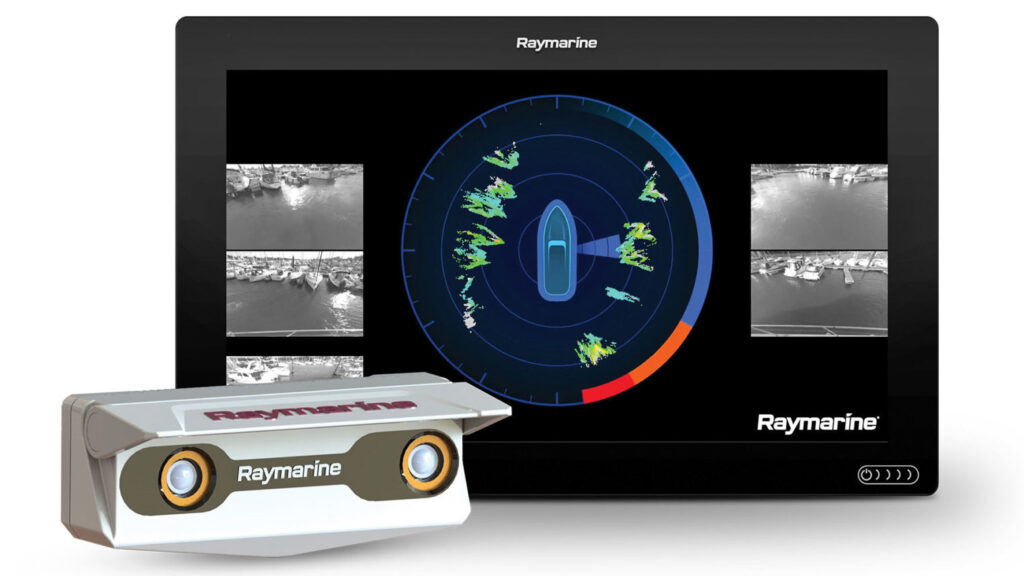
When searching on search engines or chatting among marine technology enthusiasts, the first name that comes up regarding assisted mooring systems is Docksense, a Raymarine technology. It is undoubtedly one of the most advanced and commercially widespread systems. Here, the influences from the automotive world are obvious. In fact, Docksense relies on five thermal cameras that can cover every side and angle of the boat: these sensors see everything, from the dock of the berth to the vessels on either side of our mooring. Once obstacles are identified, Docksense “assists” but doesn’t “drive” the mooring, leaving control to the boater, who can rely on a virtual fender. In short, this advanced assisted mooring system signals obstacles and takes control only in case of pilot error to avoid impact.
Where Automatic Mooring Assistance Began
We certainly didn’t arrive at a tool like Docksense immediately. The evolution of assisted mooring systems began about a dozen years ago, with the first prototypes tentatively proposed by engineers, startups, and major manufacturers, starting with the study of difficulties encountered by skippers during mooring (a survey conducted by the German Institute of Nautical Science and Tourism even recorded sailors’ heart rates during navigation, discovering that in many cases, the rhythm shot up precisely when entering the port for mooring). The most convincing prototype was probably that of the German company ComfoDrive. The system didn’t include sensors: instead, it was a joystick connected to a stern engine and a bow thruster, allowing control of the throttle and gear. The first tests were conducted on a 43-foot Beneteau. And it was precisely this shipyard that first included this option in their models, with Dock & Go available on hulls from 50 feet up.
The Italian Assisted Mooring System
Today there are several assisted mooring systems available on the market. There’s for example the Dockmate system, which comes from PPA, and therefore from Belgium, featuring a mobile joystick that allows maneuvering from any point on the boat to always find the best view. But there are also Italian mooring systems, like Yacht Controller, which is based on a radio control system. Or the ECAB system, also Italian, which combines data from a camera with information from GPS, radar, accelerometers, and compass, assisting the pilot with a myriad of information, providing real-time alerts, accompanied by precise distance measurements from obstacles in every direction.