Is it forbidden to enter ports and dock under sail? Currently, there does not seem to be any article in the navigation code that explicitly prohibits it. In practice, following ordinances issued in all ports, entry and docking at the quay under sail is prohibited everywhere.
Considering the limited maneuvering space in marinas or port areas, the intensity of traffic, and the average boater’s limited inclination for sailing maneuvers in confined waters, this is a safety measure more than justified.
However, in case of emergency and extreme necessity, it may happen that we need to get out of trouble by relying on our skill in maneuvering under sail in confined waters. If the engine fails before entering the port, there is the possibility to sail away, giving oneself time to find a solution or, if necessary, opt for requesting a tow. However, the engine may fail at the last moment, or there may be no possibility to contact shore assistance.
In essence, docking under sail is not a difficult operation. In fact, it mostly involves applying the techniques used during many buoy pickup exercises to a docking maneuver, albeit with minimal error margins. In less complex cases, what we indicate below are maneuvers with docking under sail alongside the quay in the English style.
As often happens, with these proposals, one must consider the many variables that characterize operations at sea: the boat’s momentum, wind intensity, distances to cover. These elements make the basic nature of the maneuver a bit more complex and support the main rule that one should always dedicate time to the pleasure of sailing maneuvers, especially in terms of safety.
Docking under sail with wind coming from the quay
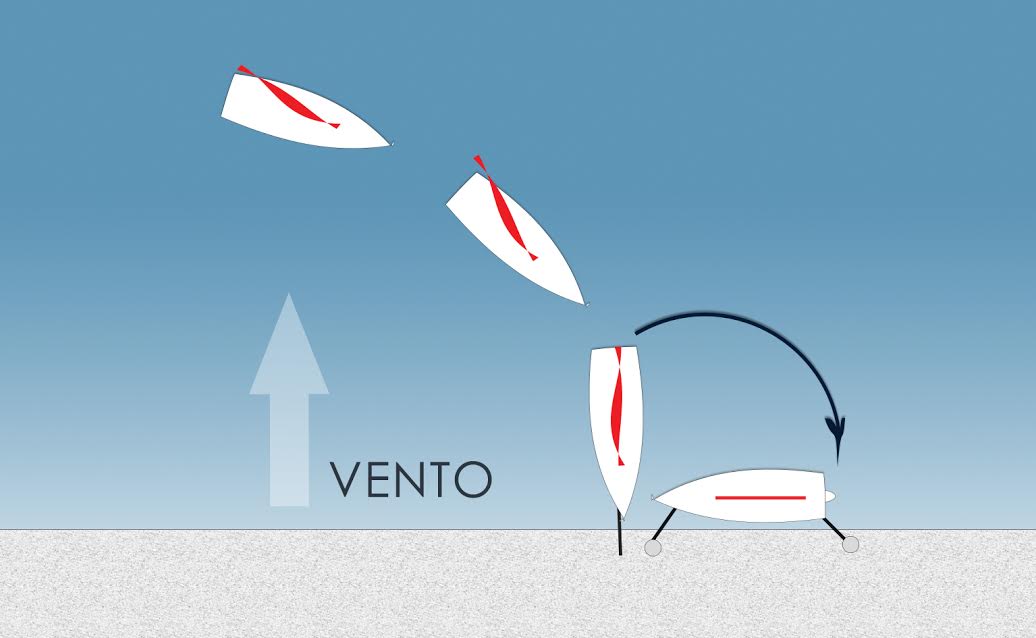
This is the situation most similar to a buoy pickup, except that in front of us, we will have a concrete wall, so it is better to arrive short, bear away, and redo the docking, rather than arrive too long with the consequences that may entail.
Approach close-hauled, adjusting the angle based on the distance needed to dissipate the momentum. In this phase, we can manage the speed by luffing the jib and mainsail until we bring the bow into the wind to dissipate all speed and decide to stop with the bow very close to the quay.
Even before bringing the bow into the wind, the jib should be furled or lowered to free the bow and allow those who need to throw the line ashore or jump directly to operate without obstacles and potential dangers.
At this point, with the bow secured ashore, we can warp the boat and dock alongside by passing a line from the stern.
How to maneuver if the wind is parallel to the quay
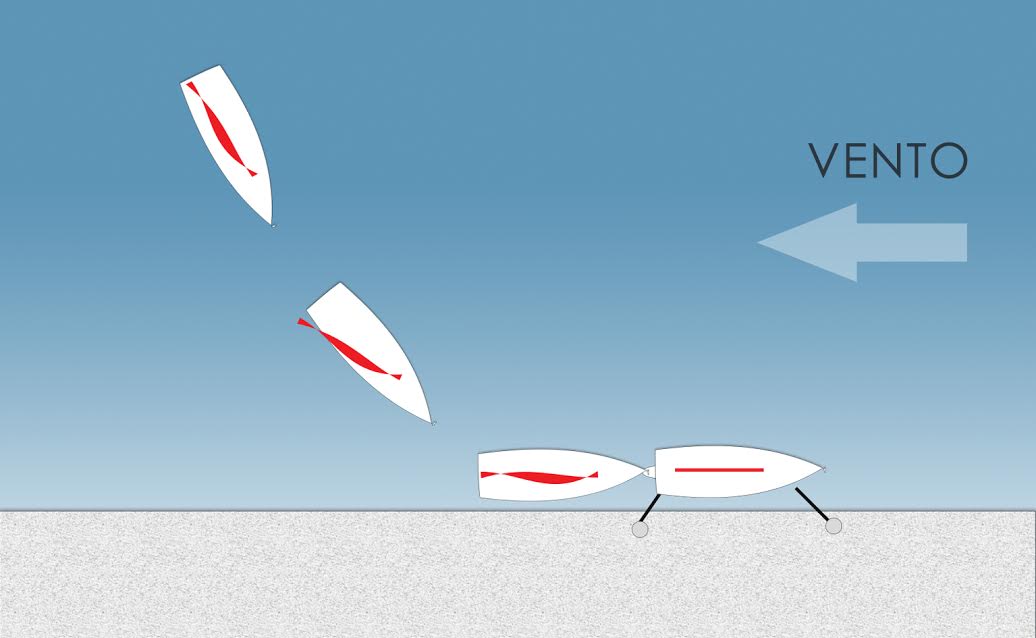
If the wind is parallel to the direction of the quay, the approach for docking in strong wind will always be upwind but with a narrower angle. With more maneuvering space along the pier, docking will be easier than before because there is more room to dissipate the boat’s momentum once upwind. Even in this situation, as we approach, we can control the speed by adjusting the sails, tightening and loosening to add or reduce power, until the point where, before heading upwind, it becomes more appropriate to furl or lower the jib to free the bow.
Exactly as with a motor maneuver, but certainly with greater precision since we cannot use reverse, we must try to achieve an angle that allows us to luff into the wind and stop in the space where we have decided to dock. Since there is no opportunity, as mentioned, to stop the boat with a reverse thrust, it is essential to know the boat we are operating on and therefore calculate its momentum.
When we are about a meter from the quay with the bow, at a reduced speed for maneuvering, we can head upwind so that the mainsail and jib (if not already furled) flutter, contributing to resistance against forward movement. When the boat is almost stationary, a crew member will then have the opportunity to throw a line ashore (if someone at the marina is available) or step onto the quay to help stop the boat’s motion, secure the bow line, and run to the stern to receive the second line.
Docking in the harbor with the wind angled to the quay
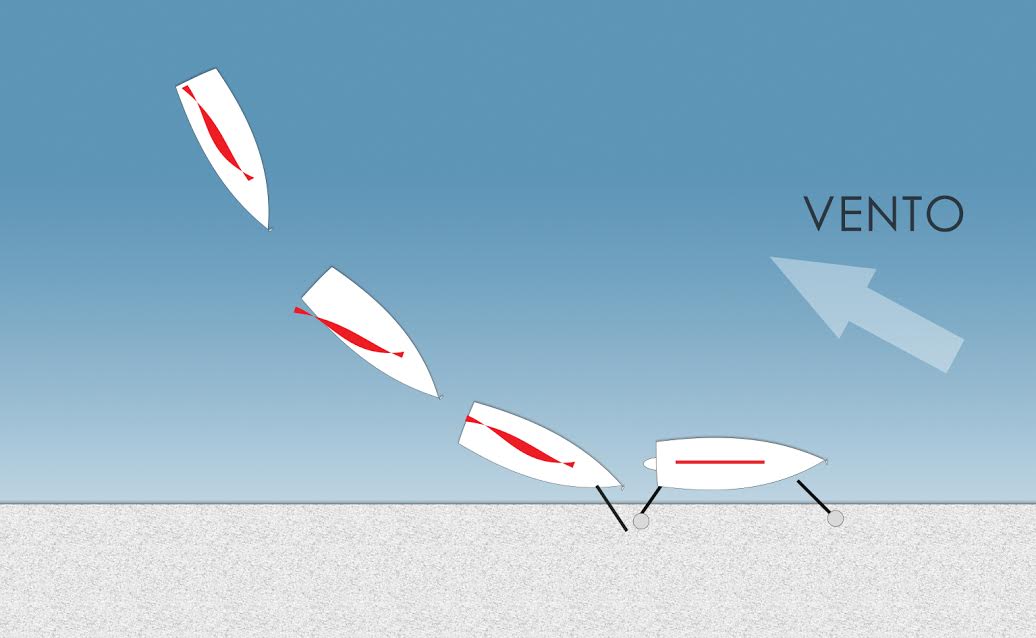
In this situation, the approach should be almost perpendicular to the quay to proceed with an upwind course. The method is the same as previous operations, although care must be taken with the distance from the quay as we will find ourselves with the bow upwind with the boat angled to the quay. Once the bow is upwind, it would be advisable to still have a minimal momentum to move with the tiller, after passing a line ashore, to dock parallel to the mooring. Due to the wind, the boat will tend to drift away from the marina quay, so the role of the person ashore is crucial to quickly secure the bow mooring and then receive the stern line to warp the boat.
To reach your berth at the Genoa Marina Porto Antico, you can always rely on the cooperation of our dockhands: at the Genoa marina center, we are always here!