

Shouting, boats turning sideways, insults, and mutual accusations. Such scenes are often witnessed on marina docks during mooring maneuvers. The confined spaces, the wind’s influence on the slowly moving boat, and the fear of causing damage often generate a state of anxiety greater than the situation warrants, which increases the likelihood of errors. Moreover, the widespread belief that a good sailor is judged by how they maneuver in port puts additional pressure on our self-esteem. Regardless of the miles under our belt, a botched mooring can damage our reputation for years. For this reason, based on the many scenes witnessed at our Genoa marina, we have decided to provide some valuable—albeit basic—tips for a perfect mooring. Enjoy reading!
No Two Moorings Are the Same
Certainly, you can moor countless times in the same berth. However, each mooring is actually different, as factors such as wind, waves, fatigue, weight distribution, the position of the neighboring boat, and lighting all change.
All types of mooring for alongside berthing, with beam wind, pushing us towards the dock or pulling away, with current…in all cases, these have always been general guidelines: each maneuver is different from another even when performed on the same boat and in the same location.
Therefore, it is essential to know how to handle situations not only from a technical perspective but also from a psychological one, and thus know which strategies to adopt to reduce anxiety and consequently remain more clear-headed and eliminate the possibility of making mistakes.
Tips for a Perfect Mooring: Prepare Everything in Advance
The golden rule, from which all other observations stem, concerns the need for preparation: knowing your boat and the mooring location, preparing the equipment, and ensuring the crew is ready and trained. If possible, it’s also good to always choose the easiest solution, without improvising on the spot, and be certain that everything has been calmly arranged: these precautions make our approach much more confident, resulting in reduced anxiety levels.
Whether it is a sailboat or motorboat—unless it is your own familiar vessel—before maneuvering toward the marina dock, you must verify the responses you receive and assess the movements in confined waters: how it loses momentum and the turning effect the propeller produces in reverse. By executing a 180-degree turn, you should evaluate how it turns at slow speed, how it reacts to bursts of reverse and forward gear while attempting to rotate on its own axis, and what effect crosswinds exert on the topsides.
The Importance of a Tidy Boat for Stress-Free Mooring
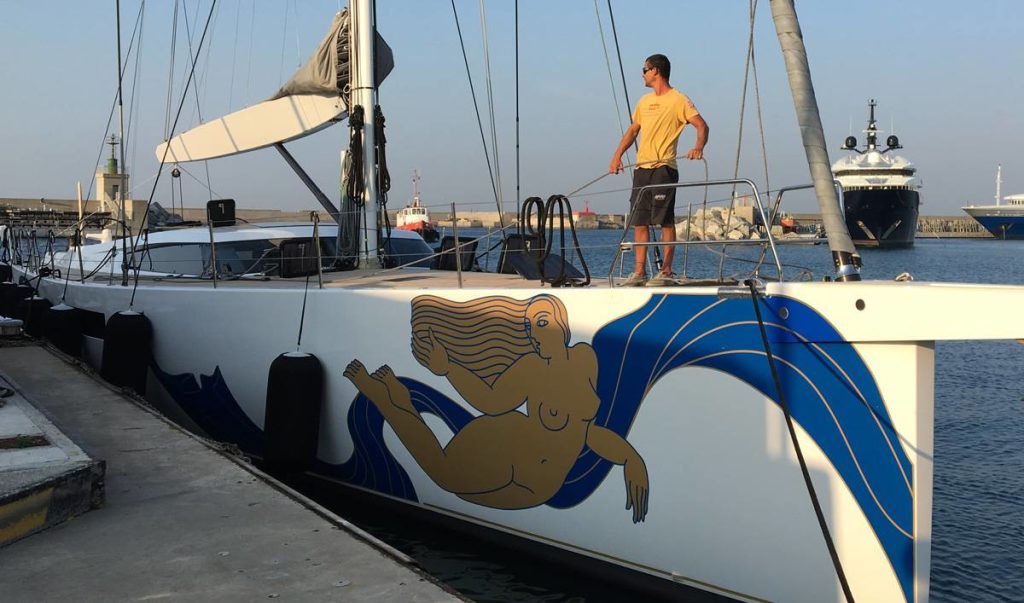
In a list of tips for a perfect mooring, the factor of order cannot be overlooked: the deck must be clear of potential hazards such as towels, glasses, and bottles of sunscreen and after-sun lotion. In the cockpit, it is very useful to have a portable VHF to communicate with the marina for instructions and to request assistance if needed. Anything hanging from the lifelines should be taken down for more than one reason: you risk soiling it with fenders, and it is certainly not dignified to arrive at the berth with underwear hanging out; moreover, everything that is hung contributes to wind resistance, thus increasing drag. Therefore, in windy conditions, it is important to close biminis and spray hoods, which also limit visibility.
It is essential to know the location where you are maneuvering, and to do so, pilot books are available, or you can perform a quick internet search, or alternatively, you can contact the marina directly (to contact our Genoa marina, visit our Contact page). Based on weather conditions, if we have a choice, we should head for a windward dock, with the wind blowing as little as possible on the beam.
Tips for a Perfect Mooring: Clarity and Readiness
Among the tips for a perfect mooring, there must be one dedicated to the crew, who must be ready to follow the captain’s orders. However, it should be noted that a skipper, if not well prepared, can generate confusion and contradictory orders. First of all, therefore, it is necessary to identify people capable of executing orders correctly. Furthermore, one must be able to explain in detail, before entering the port, what position each crew member should assume and their precise roles. If necessary, positions and actions should be demonstrated concretely by simulating the movements. Then, when it comes to action, we must give clear orders in sequence, clearly indicating who should do what. Guests on board should also be considered part of the crew and, for the few minutes from entering the port to docking, they must not wander around the deck, blocking the view and creating confusion. For non-operational guests, therefore, it is recommended to remain seated in the cockpit or below deck.
Finally, it’s important to prepare yourself. Only fools never change their minds, but drastically altering a maneuver at the last moment, especially in windy conditions, is never the best course of action. Therefore, the situation must be well studied, and you must clearly define in your mind the sequence of actions, starting from how to approach the berth, knowing how to use the propeller’s turning effect, how to counter wind effects, and which line to give to shore first or which to take.
Once everything is clear, both for the skipper and the crew and guests, all that remains is to proceed while accepting help from the professionals ashore, and not forgetting that the responsibilities of executing the maneuver and making decisions should not be underestimated.
