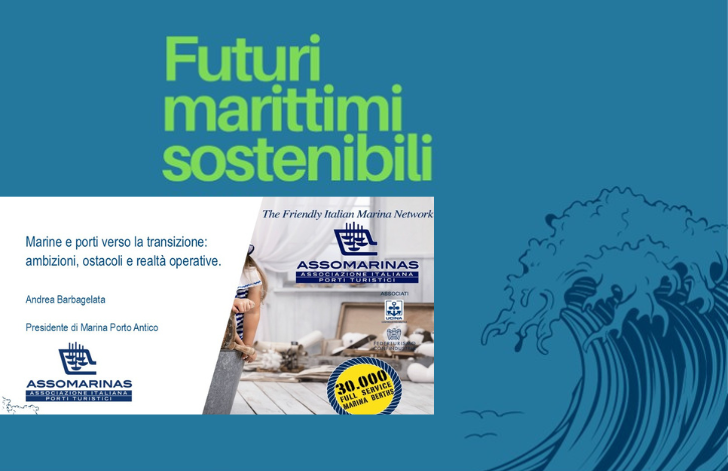
On Wednesday, November 26, at Palazzo Imperiale, just minutes from our Genoa marina, an important meeting took place between engineering, industry, and nautical infrastructure: the ‘Sustainable Maritime Futures’ event was an opportunity to explore new energy frontiers in the yachting and passenger transport sector, with interesting insights for tomorrow’s green marina.
The conference featured presentations from representatives of key players in the nautical world, including Vulkan Italia, Ranieri Tonissi, Newcleo, Coast Guard, Rina, ENI, and Assomarinas. Representing the Italian Association of Tourist Ports at the meeting was Andrea Barbagelata, vice president of Assomarinas and president of Marina Porto Antico, who in his presentation illustrated Assomarinas’ approach to the topic, which aligns with our Genoa marina’s philosophy.
The Energy Transition Challenge for Boating and Tourist Ports
Multiple times in our Genoa marina’s blog, we have emphasized the need for a green transformation in recreational boating, while highlighting the inevitable challenges of this journey. During the conference at Palazzo Imperiale, Andrea Barbagelata noted the various energy vectors that can be valuable for the
The obstacles to boat electrification are well-known, primarily represented by limited range, significant battery weight, and long charging times; however, other options also bring considerable drawbacks, from high costs of implementing hydrogen refueling infrastructure to the reduced energy density of methanol.
Infrastructure for a Green Marina
After reviewing the main energy vectors for boating, Barbagelata’s presentation continued by indicating the necessary infrastructure for a green marina aiming to utilize more sustainable alternatives. It starts with the necessary grid enhancement to meet the needs of vessels
A green marina wishing to offer this opportunity to boaters would need to choose between on-site hydrogen production (thus installing electrolyzers and storage stations) and refueling (which would require bunkering stations). The complexities would be lesser for methanol, with the possibility of converting existing diesel distribution systems and tanks.
Assomarinas’ Activities
As highlighted by Marina Porto Antico’s president during the ‘Sustainable Maritime Futures’ conference, Assomarinas is playing a proactive role in guiding Italian marinas and tourist ports towards adopting new technologies with reduced environmental impact. Specifically, to support the green marina, the association has established synergistic collaborations with various entities, including Nat Power for hydrogen refueling networks, Aqua Superpower for high-power rapid charging stations, and Sanlorenzo for operational safety procedures for methanol bunkering.
Also noteworthy is the collaboration with ICOMIA (International Council of Marine Industry Associations) to promote the distribution of HVO biodiesel (Hydrotreated Vegetable Oil), which can be used without any modifications in existing diesel engines. Assomarinas has thus laid the foundations for tomorrow’s green marina, identifying the most promising technologies and partners best aligned with marina needs.
Towards a More Sustainable Marina
Barbagelata’s presentation concluded with the key steps in the strategic transformation of a green marina, which must approach tomorrow in a holistic and integrated way: this involves careful planning of spaces for new energy infrastructure, renewable energy production, and necessary steps in safety and training.
The path that a green marina must face is neither short nor simple. However, there is no doubt that the goal is to achieve a marina with reduced environmental impact, to accommodate more environmentally friendly vessels in its berths, from small boats to superyachts.
Marina Porto Antico itself is working to make its infrastructure more sustainable, starting from promising foundations: consider, for example, the extensive charging infrastructure for electric vehicles in the port’s reference parking area, in the historic center of Genoa and steps away from the berth; or the latest generation dock service pedestals, which allow us to offer boaters very precise consumption-based billing, leading to significant responsibility from boaters. Among our berths, therefore, energy and freshwater waste is minimized.
However, the work to improve our marina and make it a green marina doesn’t stop here: several other interventions are planned to considerably reduce the environmental impact of the Genoa marina, with the awareness that boaters themselves want to protect the magnificent Italian and Mediterranean nature.