
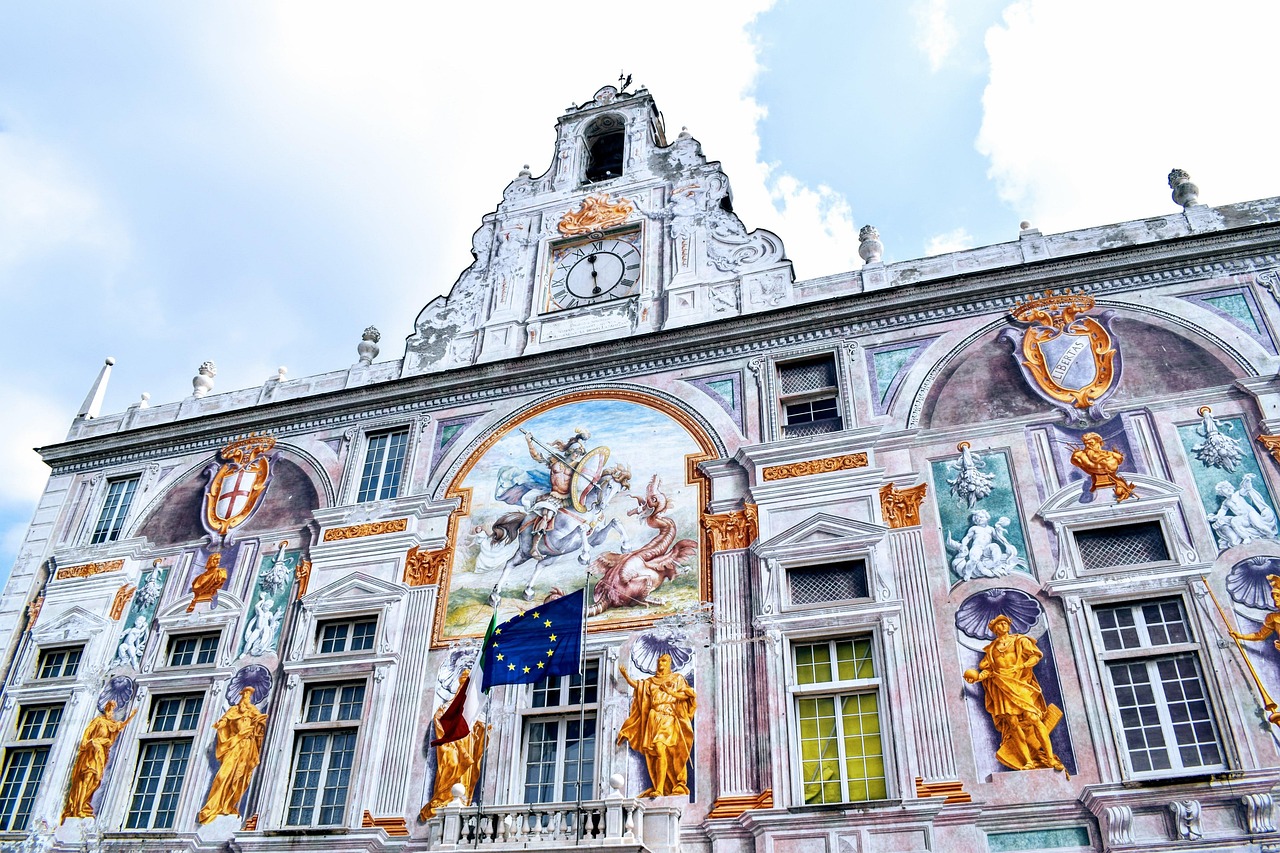
Genoa certainly has no shortage of stunning palaces that leave you breathless at first sight: one’s mind immediately goes to the famous Palazzi dei Rolli, which are quite rightly a UNESCO World Heritage Site, from Palazzo Rosso to Palazzo Bianco, and on to the Royal Palace. There is, however, one particular palace outside the most popular tours to which we at Marina Porto Antico are particularly attached: perhaps because it is just a few hundred meters from our berthsberths, perhaps because it is the historic headquarters of the Western Ligurian Sea Port Authority, or perhaps because its halls have hosted important events for our port of Genoa. For one reason or another, when we cross Piazza Caricamento – which has recently undergone a restyling – our gaze cannot help but fall upon the majestic facade of Palazzo San Giorgio: in this short blog article, we will explore the history of this important building, its current function, and the opportunities to visit it.
The history of Palazzo San Giorgio and what it is today – in brief
We are, as mentioned, just a few minutes’ walk from the quays of our Genoa marina, in the heart of the Molo district: Palazzo San Giorgio looks out on one side toward the sea and the Porto Antico, on the other toward Piazza Caricamento, and behind toward the Genoa of the carruggi.
The palace was erected in the thirteenth century, when the Captain of the People Guglielmo Boccanegra decided to build a ‘civil’ palace so prestigious as to rival the expression of religious power, none other than the Cathedral of San Lorenzo (then in its Romanesque form, before being rebuilt with Gothic architecture at the beginning of the fourteenth century). It is said that in this civil palace so close to the port of Genoa, there were also prisons for a long time, where even Marco Polo stayed (imprisoned by the Genoese in 1298, during the naval battle of Curzola).
In 1340, Palazzo San Giorgio began to move toward the role we know today, with the establishment of the first magistracies for controlling port traffic, and thus the customs office. The offices of the Compere were also located here, tasked with managing money loans made to the Municipality by private citizens. It was from the union of these Compere that the Casa delle Compere e dei Banchi di San Giorgio was born right here: thus began in 1407 the history of the Banco di San Giorgio, recognized today as the first institution to operate as a modern central bank.
Centuries later, in 1903, Palazzo San Giorgio returned to the port, becoming the headquarters of the newly formed Autonomous Consortium of the Port of Genoa. A role that seemed destined from the start: it appears the design of this building was signed by Friar Oliverio, the same monk who years earlier had designed the extension of the Molo Vecchio.
What to see and how to visit Palazzo San Giorgio in Genoa
As the headquarters of the Port Authority, Palazzo San Giorgio is not always open to the public. However, special openings are frequently organized, often accompanied by those of other institutional buildings: we think of the ‘Palazzi svelati’ event as well as “Domeniche a Palazzo” and “Domeniche di Carta” or even “Port Days”, “Rolli Days” and “Giornate del Fai”; days during which guided tours are organized in the most interesting spaces of the palace.
Due to its history, its role, its architecture, and its position just a few meters from the port of Genoa, Palazzo San Giorgio is certainly among the most significant in our city. Everyone who visits our city is struck by the grand Renaissance facade facing the sea, at the center of which stands the figure of Saint George slaying the dragon, surrounded by paintings of the fathers of the homeland.
Inside, there are many rooms that captivate at first sight: we think of the rich loggia, but also the large halls of the palace, from the Sala delle Compere, with its statues and large paintings, to the Sala del Capitano, with its stunning polychrome relief tiles of Arabic craftsmanship (the so-called azulejos). Among the most interesting elements are the large statue of the Madonna Regina and the tax filing cabinet.