
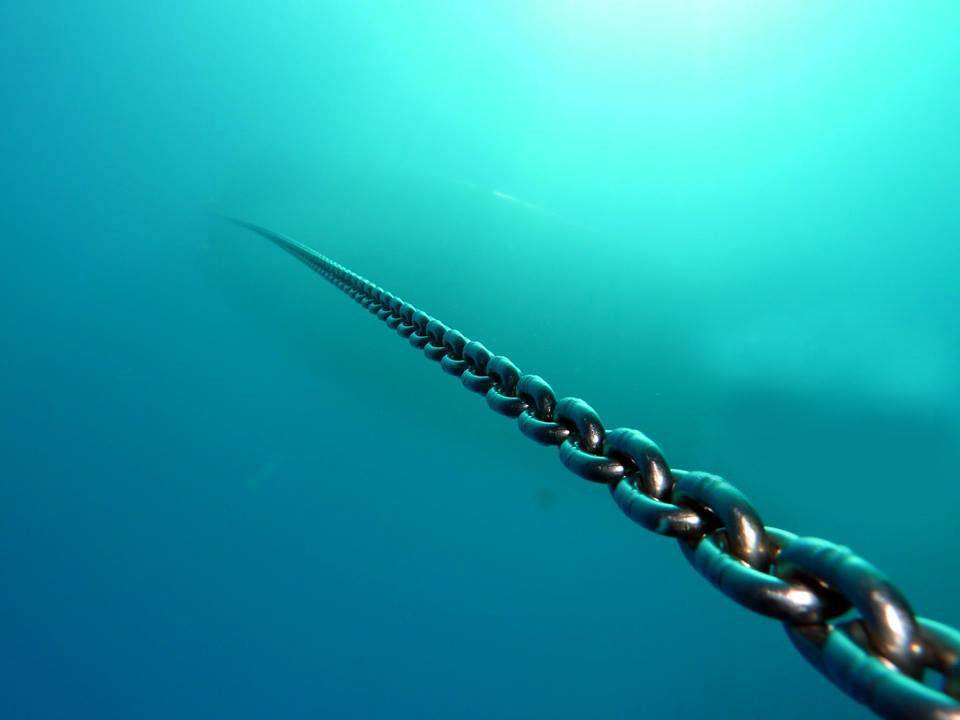
Here’s how to weigh anchor and what trick to use to free our fouled anchor
We have decided it is time to head back out to sea: generally speaking, it is not a complicated maneuver, especially in the absence of wind. But some precautions must be taken, and if we end up hooking another chain—which is not difficult in crowded anchorages—here is how to get out of it.
The steps to free our fouled anchor
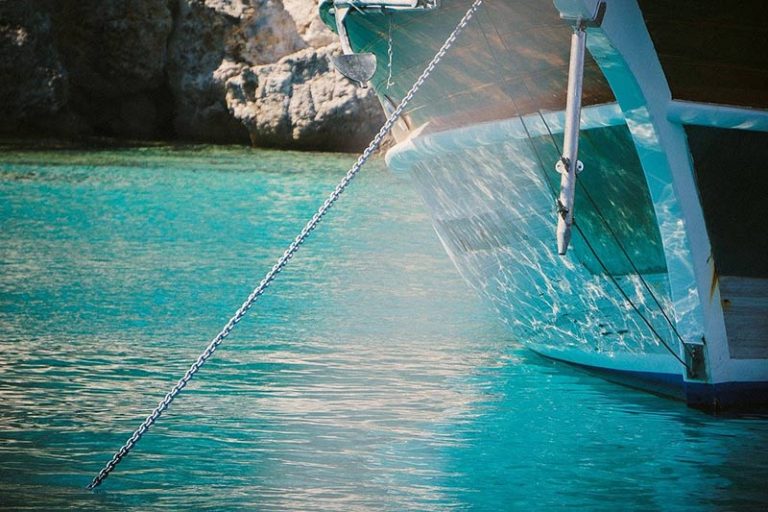 The first thing to do is follow the instructions of the person at the bow who will tell us how the chain is oriented, and if and how much engine power to give. The matter of propulsion is important. Moving forward a few meters will allow us to relieve tension from the chain and therefore the strain on the windlass.
When the anchor is fouled in light wind conditions, if we don’t want to use forward gear, we can exert traction on the chain by operating the windlass but only a few meters at a time, then stop, wait for the boat to move forward on the chain releasing tension thanks to the previously applied traction, before starting again with the electric windlass. Continuous traction would put excessive strain on the windlass risking damage.
Pay attention to the anchor locker dimensions. If the anchor well is deep enough, the chain will descend into it properly without creating problems.
If it is a shallow locker, the chain will pile up under the base of the windlass, eventually jamming or even causing the links to jump off the gypsy, with the risk of the entire chain running out to sea.
To avoid any issues, we must stop the operation every couple of meters of raised chain, spread the chain under the windlass by hand or with a boat hook, then resume the operation.
Well before the fouled anchor breaks free from the bottom, when there are only a few meters of chain left in the water, the boat will no longer be held in place; therefore, it is important to have someone in the cockpit capable of maneuvering with the engine and rudder to maintain position and not drift onto nearby boats, ready to move once the anchor is freed, even if it is still partially submerged.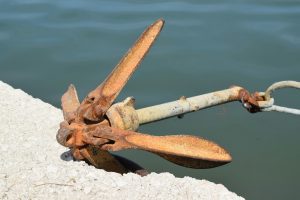
It may happen that during this maneuver we hook someone else’s chain or line with our anchor. There are devices available on the market that can make our life easier, but in this case, a line and a boat hook will be more than sufficient to get us out of trouble.
Line and boat hook to free the anchor
With our windlass, raise the anchor as close as possible to the sea surface.
Then take a line and secure one end to a cleat and make a loop on the other end, lowering it until it meets the chain under which our anchor is caught.
With the boat hook, catch the loop making sure our line passes under the chain creating a bight. Once the loop is brought aboard, tighten the line as much as possible and secure it to a cleat.
Now we can pay out some scope and thus free our anchor securing it to the bow roller. To free ourselves completely, we just need to untie one end of the line used to lift the chain which will then fall back to the bottom.
Engine on and away we go. Naturally from Marina Porto Antico!
Fouled anchor: questions and answers
How to reduce the chances of ending up with a fouled anchor?
There is no doubt: the first and essential rule to avoid fouling the anchor is to anchor at a sufficient distance from other boats. In the busiest anchorages, especially in the height of summer, this is not always possible: it therefore becomes important to “interpret” other people’s anchorage lines.
What is the difference between a fouled anchor and a snagged anchor?
The answer is simple: a snagged anchor is typically stuck on the seabed, perhaps wedged in a rock. On the other hand, we speak specifically of a fouled anchor when the obstruction is another anchorage line.
Which devices allow the situation to be resolved quickly?
We have seen that with a line and a boat hook, it is possible to free the anchor in a few minutes, with good technique and a bit of patience. However, it must be said that there are also specific devices that can make it even easier: there are slider devices that allow you to change the position of the anchor from on board, so as to free it without using a boat hook.
With one technique or the other, the important thing is to always stay calm. In an emergency—such as an approaching storm—you may eventually decide to abandon the anchorage line to resume navigation immediately, in order to take the boat to a protected port.