
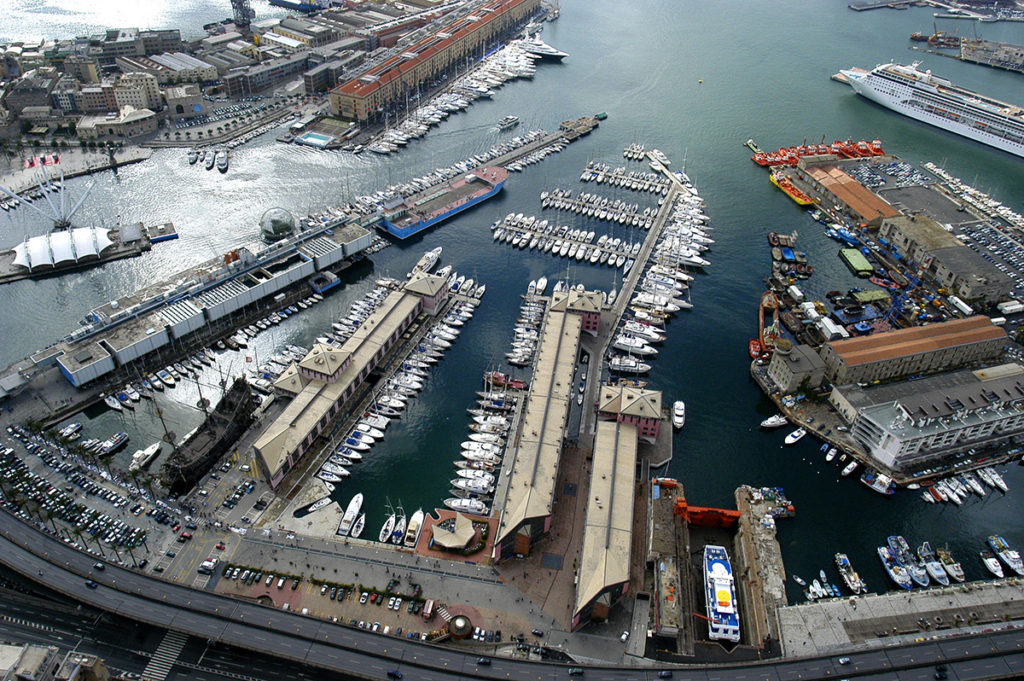
Anyone engaged in a mooring maneuver in a marina often sees the boat already at the leeward dock as an excellent support point; conversely, the owner or skipper of the already moored boat often experiences moments of great anxiety while waiting for the newcomer’s maneuver to conclude quickly and without damage to the vessels. We have obviously seen many scenes like this here in our Genoa marina, and we therefore want to remind you of the main rules and give some valuable advice on how to moor using a neighboring boat without causing damage!
Mooring using a neighboring boat without causing damage: how to do it
The boat next to ours truly represents a great help. As a reference point, as support to correct a trajectory, as a point to hook onto. However, if you choose to use a support boat, it’s important to maintain proper behavior, eliminating risks of causing damage to the boat you’re asking help from, and acting safely for ourselves and our crew.
Using a boat hook to pull or push by leveraging the neighboring boat is possible, but it must be done the right way. Let’s start by establishing three fundamental points.
Watch where you apply pressure
The first concerns the pushing and pulling forces we exert on the boat next to us. These must be applied to suitable points that are structurally capable of withstanding stress.
Watch how you use your hands
The second concerns our limbs. We can use them, albeit very rarely, but always being careful to never put ourselves in positions where we might get trapped in any dangerous position and always remembering that the cases where this can be done safely and effectively are truly limited.
The smart use of a boat hook
The third concerns the boat hook. We must grip it keeping our body sideways to avoid recoil.
Tips for pulling up alongside another boat in the port
It’s also important to remember never to approach an already moored boat and dock without having the right number of fenders to protect both us and the other boat, keeping at least one spare fender in hand, ready to use if needed.
That said, if we want to use the boat hook to approach or push away from a boat, we can do so by hooking onto a cleat, or a shroud or gunwale. Never use a lifeline or stanchion as a pulling point, as they are not structurally suitable to withstand this type of stress.
Even when pushing with the boat hook, you can do so using the base of the wooden or plastic pole and always applying pressure on the gunwale.
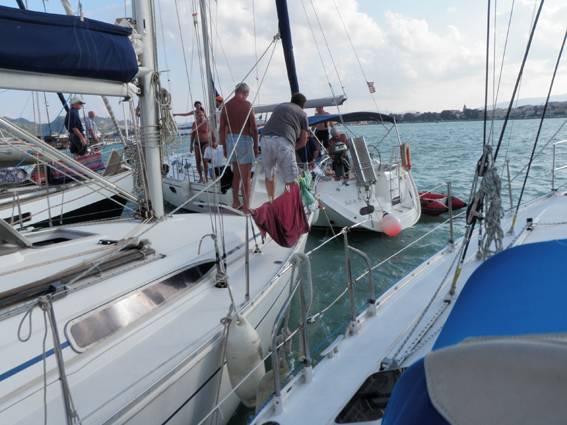
Sometimes incorrect behaviors are observed even when using hands, such as when force is applied to the lifelines of the adjacent boat. If we want to get closer, we can pull by grabbing the shroud of the boat next to ours, while if we want to move away, we can push with one foot on the gunwale but being careful to keep the other leg outside our lifelines. Otherwise, there’s a risk that if the two vessels move apart for any reason, we could find ourselves dangerously splitting our legs.
Often people are seen pushing the boat away while sitting on the side deck with both feet resting on the gunwale of the neighboring boat. This can be done but with great attention to the mooring, which must already be completed. Otherwise, there’s a risk of dangerous recoil or slipping forward under the lifelines. Injuries during maneuvers in the berth are not as rare as you might think!
Finally, it’s essential to remember never to put hands between one hull and another, as the risk of serious fractures is very high. Regarding the safety of the vessel you’ve chosen to use as support, it’s important to avoid using the boat hook on weak points such as lifelines and stanchions, and to avoid exerting pressure on the deck and side decks.
Mooring using a neighboring boat without causing damage: FAQs
Is it always permissible to use a neighboring boat during mooring?
Yes, but with the utmost care: the boat next to you can be a help, but always with full respect for the other person’s hull.
What is the safest way to avoid damage when pulling alongside?
Correctly preparing the fenders, proceeding very slowly, and maintaining full control of the maneuver minimizes the risk of impacts and excessive pressure on the other vessel.
Can a boat hook be used on any part of the neighboring boat?
No, it is important to choose only structurally solid points such as cleats or toe rails, avoiding more delicate elements like lifelines and stanchions.
What are the main risks for the crew during these maneuvers?
The greatest dangers involve crushing, loss of balance, or sudden movements of the boats that can cause falls or injuries. It is therefore better to proceed calmly, thinking ahead about the movements of the two boats involved.